Luxury Watch H1 2026 Report
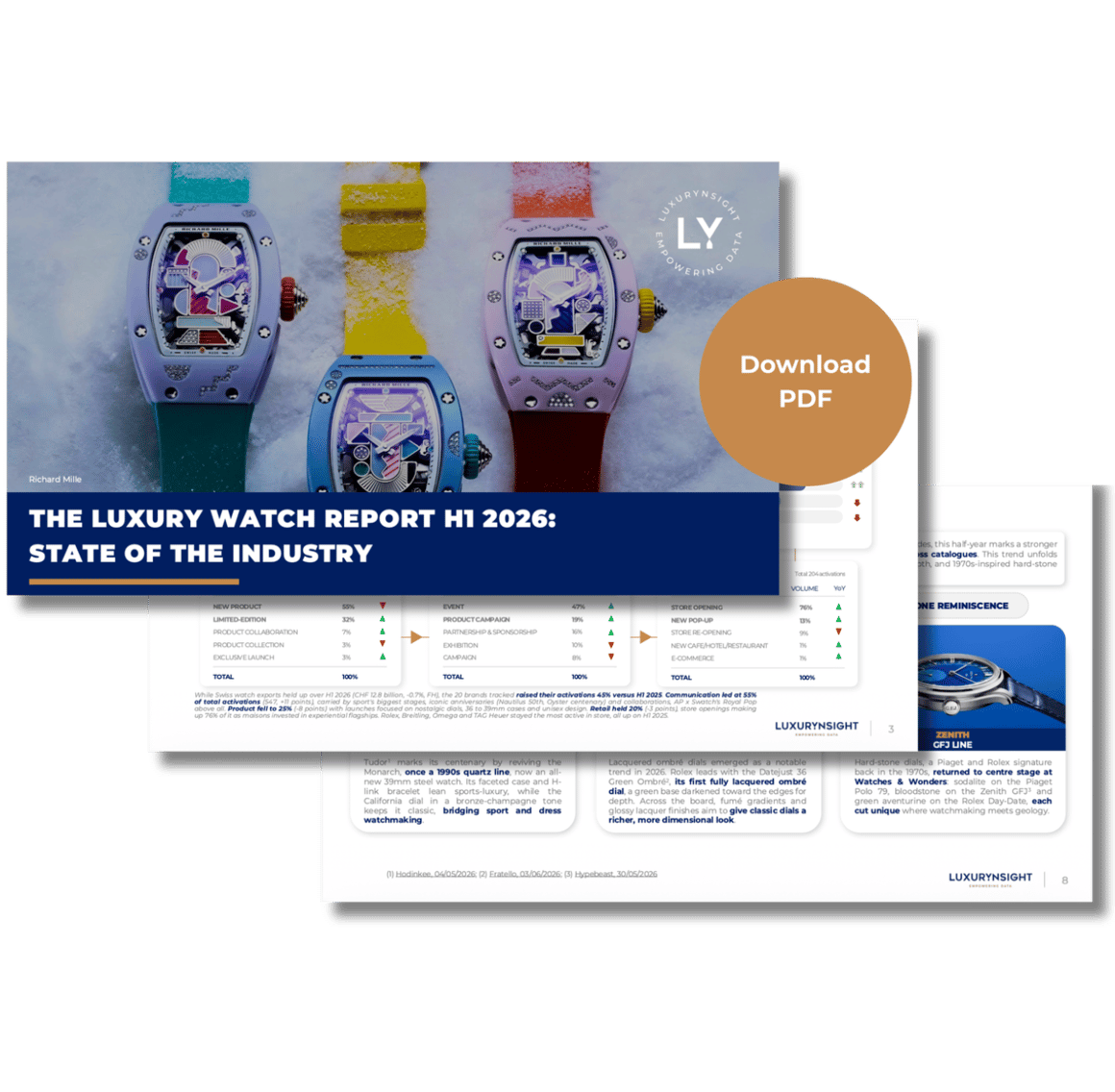
Discover how luxury watch brands are redefining their strategies in H1 2026, from regional market shifts and bolder brand storytelling to heritage-led design, sport and immersive retail experiences.
In this Luxury Watch H1 2026 Report, explore how 20 leading maisons, from Rolex and Omega to Audemars Piguet and Richard Mille, are navigating a stable yet uneven market. Powered by LY Watch, LY News and LY Price, the report unpacks the key activations, product directions and communication strategies shaping the luxury watch industry in the first half of 2026
H1 2026 Luxury Watch Overview
Swiss watch exports reached CHF 12.8 billion in H1 2026, but the year on year comparison needs context, as the first half of 2025 came before the 39% US tariffs, later cut to 15% in November. Asia stayed first and stable thanks to Hong Kong, while Germany fell 10.5%.
Brands answered with more activity, and the mix shifted. Communication grew by 11% while product launches fell to 25% of activations and retail to 20%. Rolex, Breitling, Omega and TAG Heuer were the most active in store.
KEY TAKEAWAYS
- A broadly stable market masks uneven regional performance. Swiss watch exports fell 0.7% in value in H1 2026, while volumes rose 2.3%. US weakness contrasted with growth in India and Mexico, making geographic diversification increasingly important.
- Communication takes a larger share of brand activity. Activations increased 45% across the 20 maisons tracked, with communication accounting for 55% of the total. Sporting partnerships and cultural collaborations expanded opportunities to reach audiences beyond established collectors.
- Heritage and smaller proportions shape product development. Vintage-inspired dials, hard stones and 36–39mm cases featured prominently in launches. Maisons combined recognisable design codes with mechanical innovation and broader unisex appeal.
- Cross-industry collaborations broaden access, with conversion still unproven. Partnerships such as Audemars Piguet × Swatch generated attention among younger audiences. Their longer-term value depends on whether that interest translates into lasting engagement and future purchases.
- Boutiques deepen the relationship with collectors. Store openings represented 76% of retail activations. Larger flagships increasingly incorporated private lounges, hospitality and cultural spaces, placing personalised experiences at the centre of client engagement.
- Selective consolidation strengthens portfolios and specialist capabilities. Brand transfers, retail acquisitions and supplier combinations reflected distinct efforts to sharpen positioning, expand distribution and secure watchmaking expertise.